• Home
  • About the Author
  • About the Blog
  • About the Book

Archive for the ‘Popular culture’ Category

The Moon and Easter

Tuesday, March 23rd, 2010

… or, “How to Make a Simple Definition Really Complicated”

Today I was chatting with a friend of mine about when Easter is this year, and he cited the well-known (and incorrect) formula: “Easter is the first Sunday after the first full moon after the spring equinox.”

Although this is a pretty good approximation, and it is correct most years, the actual calculation of Easter is surprisingly complicated. The correct definition is that Easter occurs on the first Sunday after the paschal full moon. This is an artificially calculated date that actually does not correspond to any astronomical event. The best description of the paschal full moon is that it is pretty close to a full moon that is usually the first one after the spring equinox!

How did we get into this mess? Why don’t we just celebrate Easter on the same every day each year, as we do with Christmas? And why does the moon have anything to do with it? That is actually a pretty good story that goes way back in time … back before Christ was even born.

[By the way, let me interject that I am not a practicing member of any religious faith. My main reason for being interested in the date of Easter is that I am interested in the ways in which the moon affects our culture. If you are bothered by sentences like "Christ was born," you should mentally add, "according to the Christian religion."]

Let’s start with what the Bible says about Christ’s death. Depending on the book you read, he was either crucified on the date of the Jewish Passover, or the following day. In any case, his resurrection occurred on the Sunday after Passover. Hence, in the early years of Christianity, the practice was to observe Easter on that day.

But determining the date of Passover is itself no easy matter, and that is where the moon comes in. The Jews, like many other ancient civilizations (such as the Babylonians, from whom they borrowed their month names), used a combination lunar-solar calendar. These calendars have the advantage that the new moon always falls on the same day each month; day 1 is the first day after the new moon, and day 14 is (usually) the day of the full moon. Passover was defined as the 14th day of the month of Nisan.

The mischief starts because the lunar cycle is not synchronized to the solar cycle; 365 days is a little bit more than 12 lunar cycles. So if you want the same months to occur at the same time each year (as the Jews did; Nisan was supposed to be the first month of spring, when the barley ripens), you need to insert extra months now and then. In order to prevent your calendar from becoming completely chaotic, it’s nice to have a rule for when to do it.

Fortunately, the lunar and solar cycles do match up very closely every 19 years. Earth takes 19 trips around the sun in almost exactly the time that the moon takes 235 trips around Earth. (The difference is about two hours.) This means that your lunisolar calendar needs to have 12 normal years of 12 months, and 7 long years of 13 months, in each 19-year cycle. (12 x 12 + 7 x 13 = 144 + 91 = 235.) This fact was discovered by the ancient Babylonians and the ancient Greeks; the 19-year cycle is called the Metonic cycle after Meton of Athens. In the Hebrew calendar, it became a standard practice to have long years in years 3, 6, 8, 11, 14, 17, and 19 of the cycle.

This procedure kept the month of Nisan in the spring, where it was supposed to be. However, the Hebrews fiddled with their calendar quite a bit over the centuries; in the early days, the month of Nisan was often determined simply by observing when the barley ripened (a non-astronomical definition if there ever was one!). A controversy arose among early Christians over the facts that (a) the methods used for determining Passover had changed over the years, and (b) in some versions, Passover could occur before the spring equinox. The Nicean council in 325 AD resolved the controversy by adopting the definition that my friend (remember him? See the first paragraph) learned in school.

But that isn’t the end of the story! They didn’t have high-tech computers back then, so Christians continued to use the Metonic cycle of 19 years to compute when full moons would occur. Not only that, they used March 21 as the date of the equinox, which is not always astronomically correct. (For example, this year the equinox fell on March 20.) In other words, they tied the definition of Easter to an approximation of when the full moon occurs and an approximation of when the equinox occurs. This double approximation can result in a date for Easter that is completely different from “astronomical Easter.” The discrepancy arises, in particular, when the full moon occurs very close to the equinox. For example, in 2019 there will be a full moon on March 21, which is not “after the equinox” according to the church but is “after the equinox” according to Earth and the sun. The official paschal full moon that year will be April 20, not March 21, and Easter will be celebrated on April 21 instead of March 24.

But hold on! There are even more complications to the story! Notice that the church defines the spring equinox as occurring on March 21. But which calendar are you using? The Catholic church, and most Western churches, uses the Gregorian calendar, which first went into effect in 1583. However, the Orthodox Christian church uses the Julian calendar, which differs from the Gregorian calendar by 13 days. Why do they do that? Well, because they’re orthodox. Remember that one of the points of the Nicean council was to base Easter on the way that Passover used to be determined in the time of Christ, not the way it is determined now. Similarly, if we’re using a purely solar calendar to determine the equinox, then we should use the solar calendar that was in use during Christ’s lifetime and during the Nicean council — the Julian calendar, not the Gregorian one. That’s what orthodoxy means. You don’t let things like contemporary customs or the contemporary state of science keep you from doing things the right way, i.e., the way that they have always been done.

Thus, Orthodox Easter (or Pascha) frequently differs from the Roman Catholic Easter. This year, and next year, they are the same. But in 2012 Orthodox Easter will be one week later, and in 2013 it will be a whopping five weeks later (on May 5 instead of March 31).

Interestingly, there has been a move afoot in recent years to bring the Western and Eastern customs into alignment. The problem is especially acute in parts of the world (e.g., the Middle East) where Christianity is not the majority religion and where there are also different forms of Christianity in close proximity. The World Council of Churches has proposed what seems like a sensible compromise: to stick to the Nicean definition of Easter, using the true astronomical full moon and the true astronomical equinox. In other words, to adopt the definition that my friend told me. The nice thing about this definition is that nobody has to learn anything new! And it’s not a complete win for either side. The Orthodox churches would have to change more, but the Catholic church would have to change, too (for example, in the year 2019, as explained above).

However, disputes over matters of faith take a long, long time to resolve, and so I don’t expect to see this one resolved any time soon. I expect that Catholic Easter, Orthodox Easter, and astronomical Easter will remain three different things.

But finally, getting back to the question, “What does the moon have to do with Easter?” I thought the following sentence from the World Council of Churches document answered it very nicely:

“Easter/Pascha has a cosmic dimension. Through Christ’s resurrection, the sun, the moon, and all the elements are restored to their primordial capacity for declaring God’s glory. … Easter/Pascha reveals the close link between creation and redemption, as inseparable aspects of God’s revelation. The Nicene principles for calculating the date of Easter/Pascha, based as they are on the cycles of the sun and moon, reflect this cosmic dimension much more fully than a fixed-date system.”

I hope I have managed not to offend anybody; if you are interested, here are some other sites that discuss the timing of Easter.

Wikipedia is, of course, always a good starting point. This entry on the computus gives you way more information than I have done here. This entry on the paschal full moon is short and to the point.

The World Council of Churches paper, from 1997, is here.

Apparently they’re still talking about it. Here is a pastor’s blog that says (as of 2009) they are getting closer to an agreement.

Here is a page that explains the computation in terms of a formula. Note the prominent appearance of the numbers 19 (the length of the Metonic cycle), 7 (the number of days in a week), 4 (adjusting for leap years?) and 100 (adjusting for the Gregorian calendar). And note a couple of bizarre fudge steps that have no readily apparent explanation.

I find this explanation in tabular format to be much easier to follow. Note that within any given century, the date of the paschal full moon is completely determined by the Metonic cycle.

And what if you just want to know, “When is Easter in 2010?” The answer is that the actual full moon and the paschal full moon are on March 30, and Easter is on April 4.

Tags: 19, Easter, equinox, full moon, Metonic cycle, misconceptions, paschal, Passover, religion
Posted in Just for Fun, Popular culture, Science | No Comments »

Change of Pace — and Puzzle

Tuesday, February 2nd, 2010

I will say more in the very near future about the Obama administration’s decision on the NASA budget, which was the subject of my last post. Today, however, I’d like to offer a change of pace. When I began this blog, I intended to include posts about the moon in our culture in addition to posts on the science of the moon. So far, however, I’ve done very little of the former.

I read only two web comics on a regular basis: Sinfest, written by Tatsuya Ishida, and Piled Higher and Deeper, written by Jorge Cham. Yesterday, Tatsuya had a delightful comic that has to do … sort of … with the moon.

Sinfest, Feb 1 2010

"Sinfest," Feb 1 2010

Probably no explanation of this strip is necessary. But if any of you are curious,  Sinfest is sort of about modern life and sort of about religion and is highly irreverent about both. It’s definitely satirical but I would not say it’s anti-religious. It just pokes fun at the little foibles of all religions. (Except Islam — I’ve never seen Ishida say anything, pro or con, about Islam, probably because that can be hazardous to a cartoonist’s health.)

The little Buddha on a cloud and the dog (named Pooch) are recurring characters. Every now and then Ishida draws a strip where he illustrates how the Japanese symbol (kanji) for some word could plausibly come about. I like these calligraphy strips very much. He usually plays it very straight. The humor lies, to me, in the whole idea of rationally explaining something as irrational as language. You could do the same thing with English spellings.

I’m not completely sure what the “mu!” at the end of yesterday’s strip means. When I go online and look up the free English-Japanese dictionaries, it’s easy enough to find out that the kanji shown here is pronounced “tsuki” and means “moon.” On the other hand, “mu” means “six.” Can anyone explain to me what six has to do with the moon? Or what the point of the joke is otherwise? (Perhaps “mu” is how dogs bark in Japanese?)

Tags: comics, kanji, Tatsuya Ishida
Posted in Just for Fun, Popular culture, websites | 3 Comments »

There is No Santa Claus; Is There an Enterprise?

Saturday, January 30th, 2010

For months we’ve been waiting to hear what the Obama administration response would be to the Augustine Commission report on the future of NASA’s manned space flight program. Now it looks as if we have our answer, and it ain’t pretty.

The Augustine Commission outlined four possible directions for NASA. The last two were called “Flexible Path” and “Moon First.” The first two could be called “Moon Never” (though the report used different names). The commission further argued that in order to have a human space program that our country could be proud of, NASA’s budget would have to be augmented by about $3 billion per year.

As reported here and here and many other places, it looks as if President Obama has now placed his bets on the more ambitious of the two versions of “Moon Never.” Here is what I wrote about this option in my post from September:

Moon Never, ISS on Life Support. Slightly more palatable, this option also abandons hope for sending humans beyond low Earth orbit, but it at least acknowledges that it would be a disgrace to build a space station for 25 years, operate it for 5 years, and then torpedo it. The Augustine committee said that we can keep the ISS going to 2020 by developing a smaller heavy-launch rocket and relying on commercial companies to generate cheaper alternatives for launching humans into orbit.

This pretty much describes what I have read about the proposal Obama is going to send to Congress, although we can now paint in a few more details. There is some talk that the space budget will increase by $1 billion per year (not $3 billion per year). In early January, the word was that this money was going to go to NASA but now looks as if it might go in part toward incentives for private companies to build launch solutions. Obama is definitely scuttling the Constellation program and its associated rocket, the Ares I-X. This is a bridge-burning move. Even if we changed our minds and wanted to send astronauts to the moon by 2020, or even the mid-2020s, without Constellation we wouldn’t have the hardware to get them there.

Of course I am disappointed by this decision. However, it was not the least bit surprising. In today’s economy, with talk of a budget freeze on discretionary spending, where was Obama going to find $3 billion? I consider some of the online criticism of his decision to be disingenuous; I suspect that many of his critics would have jumped on him, perhaps even harder, if he had chosen to ask Congress for another $3 billion per year for NASA.

I’m disappointed that Obama didn’t take more seriously the commission’s finding that NASA needed this money to have any kind of credible manned flight program. It wasn’t really a choice between $18 billion and $21 billion. It was a choice between $18 billion flushed down the toilet, or $21 billion producing tangible results.

I’m disappointed also that there was no acknowledgement of the fact that, after the discoveries this fall concerning lunar water, the moon is actually an interesting destination again. Even if we concede that short-term financial considerations prevent us from having a viable human spaceflight program for a few years, a leader who was truly committed to space would outline a long-term strategy and a rationale that would include sustainable presence in space as its #1 objective. The best arguments I have seen in that direction are the ones on Paul Spudis’s blog. When you make that the rationale, the moon becomes a required destination, not an optional one.

However, I do see some reason for optimism in Obama’s decision, bleak as it may seem. It really does mark a break with the past. Gone is the pretense that NASA can do everything. Until now, there was always the hope that there was a Santa Claus, that the U.S. government or taxpayers would somehow step in and make NASA’s wishes come true. It’s possible that this was in some way holding back the efforts of private companies and investors to think creatively about what they could accomplish in space.

Now, there is no other game in town. We will only get as far in space as international partners and private companies, such as SpaceX, can take us. Lovers of free enterprise should be delighted; this is a chance to show that entrepreneurs can be better at “the vision thing” than presidents. For the near future, it seems, we are hitching our wagon to a starship named Enterprise.

I personally have some doubts. I’m not sure that space exploration companies are ready to walk on their own two feet. But we are going to find out, one way or the other.

USS Enterprise

A metaphor for the future of human spaceflight?

(Image from www.startrek.com.)

Tags: Augustine Commission, Barack Obama, disappointment, Flexible Path, reality, sustainability, the vision thing
Posted in Arrive, Future exploration, Media, NASA, Popular culture | 1 Comment »

New Year, Halos and Blue Moons

Sunday, January 3rd, 2010

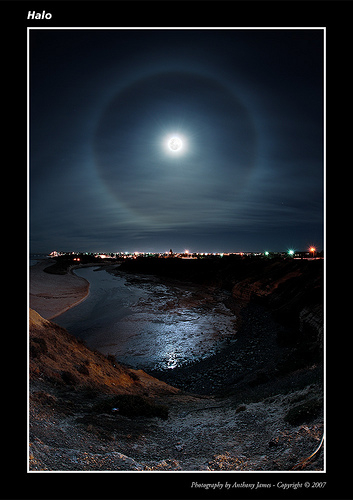
A lunar halo.

Here in Santa Cruz, New Year’s Eve brought an unusual coincidence of two astronomical events. One of them was a worldwide event: It was the second full moon of the month, or a “blue moon.”

The usage of the term “blue moon” to mean the second full moon in a calendar month actually stems from a mistake in Sky and Telescope magazine in March 1946! This article on Sky and Telescope’s website explains how the confusion arose. However, as the authors note, the new definition is “like a genie that cannot be forced back in the bottle.”

How often do blue moons occur? That is a very interesting question that you can figure out for yourself if you look at the chart on the bottom of page 2 of the article. The chart reveals an interesting fact that the authors do not mention: blue moons happen on a 19-year cycle.

To see this, notice that 1999 began with blue moons in January and March. Nineteen years later, the year 2018 will begin in exactly the same way. Why is that? Well, 19 is sort of a magic number for moon-lovers. It turns out that 19 solar years are almost exactly equal to 235 lunations. (A “lunation” is the time between one full moon and the next.) So that means if you have a full moon on December 31 this year, you will most likely again have a full moon on December 31 nineteen years from now.

There are only two things that can mess up this pattern. First of all, there is a tiny 2-hour discrepancy between 19 solar years and 235 lunar months, which eventually (over a period of twelve 19-year cycles) will move the full moon forward a day. The other discrepancy results from Leap Day. If you look again at the Sky and Telescope diagram, you’ll see that the blue moon of 2001 (in November) does not match the blue moon of 2020 (in October). According to our 19-year rule, they should be in the same month each year, but the blue moon in 2020 gets pushed forward a month because of the extra day that is inserted in February that year.

This 19-year cycle was very important in ancient times, because many cultures used both a lunar and a solar calendar. To bring the two into rough correspondence, you need 7 intercalated or “extra” months every 19 years. (That is, in 19 years there are 19 x 12 “regular” months, plus 7 “extra” months, for a total of 235.) The rule was discovered by Meton of Athens in 432 BC, and is therefore known as the Metonic cycle.

Unlike the Athenians, we use a purely solar calendar. The “months” in our calendar are no longer lunations; they are merely convenient fictions. For that reason, also, the Metonic cycle no longer has any direct effect on your life — unless you happen to be the kind of person who pays attention to blue moons!

By the way, there is one other intriguing thing about that Sky and Telescope chart. I have said that there are 7 “extra” full moons every 19 years, and so you would think there would also be 7 blue moons. But actually, that isn’t quite correct! If you look at the chart, you will count 8 blue moons from 1999 through 2017! Where did the extra one come from?

The problem is, once again, February. In 1999 there were no full moons at all in February, and therefore we had two in March as well as two in January. Thus, from 1999 through 2017 (the current Metonic cycle) we will have 8 months with an “extra” full moon and one month (February 1999) with none. In other words, we will have a NET of 7 “extra” full moons, just as we are supposed to.

**************

As I mentioned, there was other wonderful astronomical phenomenon on New Year’s Eve. This one was local, rather than global. When I went outside at ten minutes before midnight, I was stunned to see a beautiful, huge halo around the moon — just like the one in the photo at the beginning of this post. (By the way, that is not my photo. It was taken by an Aussie photographer named Anthony James, who kindly gave me permission to post it in my blog. Click here to see his Flickr page, which specializes in beautiful nighttime imagery.)

A lunar halo is much easier to understand than a blue moon. It is formed in the same way as a rainbow, by the refraction of light off of ice crystals or drops of water in the atmosphere. That night was very misty and cloudy here in Santa Cruz. In fact, according to the newspaper, we weren’t supposed to be able to see the moon at all that night. However, by 11:50 PM enough of the haze had evaporated that the moon was very clearly visible. However, there were no stars — it was as if everything in the sky had been turned off except this enormous eye looking back down at me.

That’s really what it looked like — an eye, or the photographic negative of one. The lunar halo looks like the iris and the moon looks like the pupil (white, instead of black!). I think that Anthony’s picture gives you some idea of the effect.

What an incredible night–a blue moon, an eye in the sky, and the beginning of the year, all at once! I’m certain that combination will never happen again in my lifetime.

Tags: eye in the sky, Flickr, lunar calendar, Metonic cycle, Sky and Telescope, solar calendar
Posted in Just for Fun, Popular culture, Science | 2 Comments »

  • Categories

    • Arrive (2)
    • Future exploration (6)
    • Just for Fun (10)
    • Media (18)
    • Meetings (7)
    • Missions (17)
    • Movies (1)
    • NASA (13)
    • Popular culture (4)
    • Science (29)
    • Survive (1)
    • Thrive (1)
    • websites (5)
  • Subscribe

    Subscribe in a reader
    Subscribe by email
  • Lunar links

    • The Big Splat, or How Our Moon Came to Be
    • Emily Lakdawalla – Planetary Society Blog
    • Paul Spudis – The Once and Future Moon
    • Space.com
    • Wandering Space
    • Moon-Wiki
    • Lunar Picture of the Day
    • Bad Astronomy
  • Earthly links

    • dana blogs chess
    • Dana's website
  • Recent posts

    • Hiatus
    • Obama’s Speech — Some Cheers, Some Jeers
    • Discover article on the Moon
    • New Scientist article
    • The Moon and Easter
    • Lunar water update
    • Change of Pace — and Puzzle
  • Previous posts

    • June 2010 (1)
    • April 2010 (3)
    • March 2010 (2)
    • February 2010 (1)
    • January 2010 (3)
    • December 2009 (3)
    • November 2009 (4)
    • October 2009 (2)
    • September 2009 (4)
    • August 2009 (5)
    • July 2009 (11)

Copyright © 2010 - Who Hung the Moon? | Entries (RSS) | Comments (RSS)

WordPress theme based on 9ths Current designed by web design