• Home
  • About the Author
  • About the Blog
  • About the Book

Archive for July, 2009

History Channel and “This Week’s Finds”

Friday, July 31st, 2009


Just a little update on the History Channel program … I must have talked with Adrian, the writer/producer, about fifteen times this week. Today was his deadline for the script, and he kept on checking little details with me. Even as recently as Monday he said that persons unknown had snuck some words into the script about the giant impact creating the oceans, which is NOT TRUE!!

I am not in the television biz, but it amazes me that anyone would have the audacity to put statements of fact (especially false ones) into a writer’s script without checking with the writer first. I write for the print media, and I don’t think that any of my editors would ever do that. If they did, they wouldn’t be my editor for long!

Anyway, I’m confident that Adrian is trying his best to get the story right, and I hope that he will get the last word.

Today I found a reference to the giant impact theory in an unexpected place on the Web: Physics World magazine. The article is called “The Earth — for physicists,” and it talks about four catastrophes that Earth has been through, including the giant impact that formed the moon and the “late heavy bombardment” that formed most of the moon’s large impact features. The article says complimentary things about my book, so I’m happy to reciprocate with a link to it!

I found the article intriguing for a reason you might not expect. The author, John Baez, was perhaps the first blogger on the World Wide Web. He was certainly the first physics blogger. I interviewed him one time (for reasons that I have now forgotten), and he pointed out that he had been writing his blog since before the word “blog” existed! It’s called “This Week’s Finds in Mathematical Physics,” and he has kept it going since January 19, 1993. It is now up to Week 276.

If you do the math, you’ll see that he has not written an entry every week. Nevertheless, his blog is a fantastic place to learn about math or really theoretical kinds of physics, because he thinks hard about how to explain difficult concepts in the most straightforward, informal, intuitive way. Usually, the only way you can get this stuff is to talk with someone at the blackboard. That’s what John Baez’s blog is like. A really great blackboard session. And somehow he manages to do it over and over … not every week, but pretty darned often.

Anyway, Baez is usually into very cerebral math-y stuff, and so it amazed me to see him writing for Physics World about something as concrete as how the moon formed, how we got an oxygen atmosphere, etc. It amazed me in a good way, I hasten to add.  After all, I was also in a previous life a card-carrying mathematician, and look what I’m writing about now!

Tags: blogs, giant impact, John Baez, late heavy bombardment, physics, television, world's first blogger?
Posted in Media, Science, websites | No Comments »

A colder and wetter moon?

Wednesday, July 22nd, 2009

Yesterday I went to the Lunar Science Forum at Ames Research Center, which was the scientists’ version of a Moon Fest – a chance for all the recent and current moon missions to unveil their latest and greatest findings. According to the organizers, more than 500 people registered, including 200 just since last Friday. I don’t think that all these people actually came — the main meeting room holds 300, and it was not filled to capacity. Nevertheless, it was a well-attended (and well-Twittered) event.

Yesterday the science teams of the LRO and LCROSS missions, which just launched last month, presented their data publicly for the first time. As David Morrison, the head of the Lunar Science Institute, said in his introductory remarks, “Last year most of the papers reported plans, but I’m delighted to say that most of the talks this year are about results.”

All of the LRO results are very preliminary, because LRO is still in its “commissioning orbit,” when they are still warming up and checking out the systems. By the way, I mean warming up quite literally. Most of the instruments have residual moisture in them from their time on Earth. (So do most tourists, after a few hours in the humidity of south Florida!) So they have to go through a “bake-out” period to dry out all of that extra moisture. The LRO camera finished its bake-out on July 10, but even before then (as mentioned in this entry) it started sending back fabulous pictures.

Also, scientists from two other moon missions spoke yesterday. There was one presentation on the Japanese Kaguya mission that just ended a week before LRO lifted off, and three about the Indian Chandrayaan-1 mission that is still ongoing.

The most interesting news yesterday all had to do with results that we can’t really talk about yet! One of them is so preliminary that no one can really interpret it yet. The other two are results that are going to be published soon but are currently under “embargo,” meaning that the scientists aren’t supposed to talk about them until the publications come out.

First, David Paige, principal investigator for LRO’s Diviner experiment, showed some of Diviner’s first measures of the temperatures in the moon’s permanently shadowed craters. Remember that these are supposed to be “cold traps,” where water molecules could perhaps accumulate as ice because they are too cold to float away. The first temperature readings in Amundsen crater turned out to be even lower than expected: around 33 degrees Kelvin (or 33 degrees above absolute zero).

No one had predicted such a low temperature; I think that 70 degrees Kelvin was closer to what they had expected. As Paige said, “If this is true, it’s colder than the poles of Pluto!”

From his wording, you might correctly infer that Paige is not really sure this measurement is right. The instrument has been calibrated, but he said there are some possible reasons why the instrument-measured temperature may not be the same as the physical temperature. (For example, they don’t really know what kind of surface they are looking at — rocky or soft and fluffy — and that can make a difference to how they estimate the temperature.) The instrument is still too fresh and new, and the finding too unexpected, to put a lot of stock in it yet. But what it could mean is that the permanently shadowed craters are a better cold trap than we thought.

Two other surprising results that can’t be talked about yet came out of the Chandrayaan-1 mission. Carle Pieters of Brown University reported on the Moon Mineralogy Mapper, and said that her team had made a new discovery on lunar volatiles that she can’t discuss yet. Of course, the most important potential  ”lunar volatile” is water. But, she said, “Don’t give me wine and try to dig the secret out of me.”

Then Paul Spudis, whose Once and Future Moon blog is always thought-provoking, talked about the results from his mini-SAR (synthetic aperture radar) experiment, which is also on the Indian Chandrayaan-1 spacecraft. Like Pieters, he has a result that he can’t talk about yet, but he said, “I may be susceptible to being plied with drinks!”

Mini-SAR is also looking for water ice; the idea is that ice will reflect a circularly polarized radar beam differently from rocks. (The radar wave will actually go into the ice before bouncing back, because ice is transparent.) This is similar to the way that ice was first detected at the south pole, by the Clementine mission in 1994; Spudis was the deputy leader of the Clementine science team. However, the Clementine satellite only got one brief peek at the south pole, and so its results were very ambiguous. You can’t do very much in science with one data point. Chandrayaan-1 should do much better. We will have to wait to find out just how much better it’s done.

Nevertheless, I will transcribe a fascinating exchange that occurred during the audience-questions period after Spudis’ talk. Clive Neal, the chair of NASA’s Lunar Exploration Analysis Group (which advises NASA on the choice of moon missions) went to the microphone.

NEAL: You said there were some things that you cannot talk about, but then you proceeded to talk about some of them… (Laughter from audience.)

SPUDIS: You don’t know that! (Laughter.) You’re making an assumption, and maybe it’s warranted, maybe it isn’t.

NEAL: So I’ll ask my question as delicately as I can. You showed data that seemed to be consistent with the presence of water ice on the moon. Would you care to comment on that? (Loud laughter.)

SPUDIS. No! (Laughter.) But you’re welcome to draw whatever conclusions you care to.

NEAL: Can I just rephrase the question? If I buy you a beer, would you comment?

SPUDIS: It depends on what kind of beer and how much. (Laughter.)

DAVID MORRISON: I think all of us are beginning to assume that in a month or two we’ll have a wetter moon than we do now.

SPUDIS: Well, the moon isn’t going to change. (Laughter and applause.) Our perceptions might change. But, you know, some of us have had this perception for a long time.

Make of it what you will! Just don’t blame me for breaking any embargoes.

Other tidbits and factoids from the first day of the meeting:
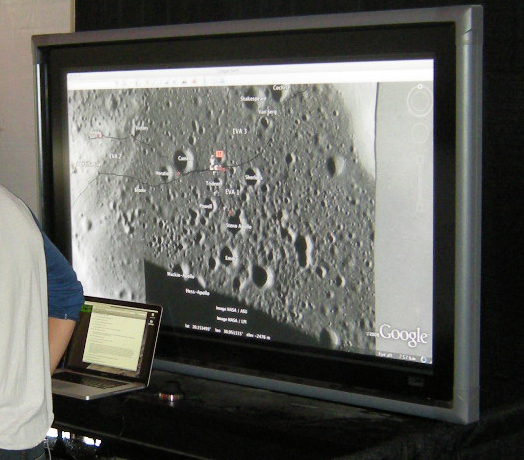
These roads are so confusing.

These roads are so confusing.

  • Google released its new version of Google Moon on Monday, and there was a large screen in the tent demonstrating it. It’s a huge improvement over the previous map-based Google Moon. This one has all the latest imagery from the LRO mission, and will continue to be updated constantly — so look for it to continue improving by leaps and bounds over the next year.
  • The LRO launch was perfect, and that is very good news for the scientists, because it means that there is more fuel left for an extended mission than they could previously count on. Craig Tooley said that this could extend the life of the mission by a year. (The spacecraft has a planned one-year life span, followed by a two-year extended science mission. I interpret Tooley’s remarks to mean that it could continue orbiting for a fourth year.) I would think that the extra time would be especially valuable for the narrow-angle camera, which can only image about 10 percent of the moon in any given year.
  • I asked Sam Lawrence, of the LRO camera team, whether they had felt under any pressure to get the pictures of the Apollo landing sites out early. He said, “I won’t lie to you. Several people in Headquarters simultaneously and independently came up with the idea of taking pictures of the Apollo landing sites. But Isaac Newton is in the driver’s seat. It was largely serendipity that we happened to be in the right place to image them.” In fact, the Apollo 12 landing site has not been imaged yet, but it should come around into the camera’s view in a couple of weeks.
  • There was lots of Twittering going on at this conference. I sat behind someone whose laptop had a screen full of twitters. I have so far refused to get on twitter.com, but those of you who are might want to check out what the scientists are twittering about.
  • Yes, there is such a thing as a free lunch! Registration for this conference was free (which is already unusual for a scientific meeting) and the Lunar Science Institute provided the lunch and refreshments free of charge, too! Shhh… Don’t tell Washington that they’re using your tax money to feed starving scientists …
Tags: Ames Research Center, beer, Chandrayaan, cold trap, free lunch, Google, ice, Kaguya, LCROSS, LRO, Lunar Science Forum, Lunar Science Institute, Twitter, water
Posted in Just for Fun, Missions, Science | 1 Comment »

Moon Fest 2009

Monday, July 20th, 2009


Yesterday I went to the Moon Fest at Ames Research Center, one of the events that NASA has organized in honor of the anniversary of the first moon landing. In every way except one, the afternoon left me very optimistic about the future of space travel.

First, one thing that impressed me was that there was a big crowd. This wasn’t “book reading at the bookstore” big or even “Friday night at the movie theater” big. It was “sports event” big, with a traffic jam waiting to get off the highway, traffic cops showing people where to park, etc. I would guess that at least a couple thousand people came. That’s pretty exciting — a couple thousand people for a science event!

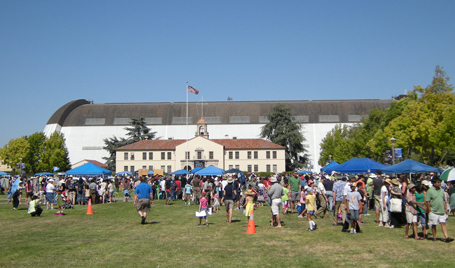
Crowds at Moon Fest; Lunar Science Institute in semi-background; Hangar One in background

Crowds at Moon Fest; Lunar Science Institute in semi-background; Hangar One in background

Of course, there were lots and lots of kids, and somewhat to my surprise there was a very well-planned choice of activities for them. They could drive robotic “moon buggies” or look through a telescope at the sun or build and launch model rockets out of paper and plastic. If your rocket landed in a “moon crater” (a big bowl-shaped piece of plastic) you would win a prize. I don’t know if the kids realized it, but this game was intended to tie in with the LCROSS mission that is currently in orbit about the moon, and will smash into a lunar crater on October 9. Here are a couple of kids getting ready to launch their rockets:

Countdown begins

Countdown begins

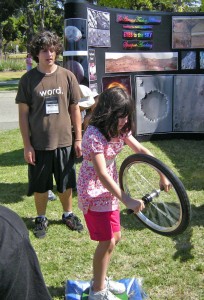
The Gyroscope Effect

The Gyroscope Effect

And here’s another girl learning about angular momentum. She is standing on a rotating platform. When she tilted the spinning bicycle wheel, the conservation of angular momentum caused her to start spinning around.

For adults or more seriously minded folks, there was also a big tent set up for lectures. I got there in time for a lecture by Tony Colaprete, the principal investigator for the LCROSS mission. I did a short interview with him afterwards, which I will write about in a future post. Again, the size of the crowd was very respectable, probably at least 300 people.

The best speaker, though, was Donald Pettit, an astronaut who has flown aboard both the Space Shuttle and the International Space Station. In fact, he was one of the astronauts who was on board the ISS when the space shuttle Columbia exploded on re-entry in 2003, and he was stranded there until he could get back home on a Russian Soyuz spacecraft. (He spent five and a half months in orbit.)

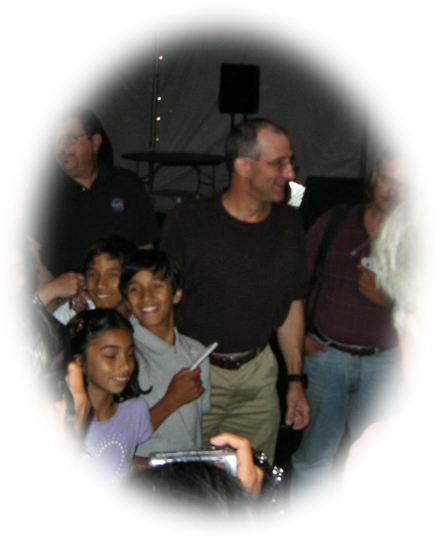
Kids love astronauts!

Kids love astronauts!

Astronauts are the closest thing that NASA has to rock stars. The questions after all the other talks were asked by adults, but after Donald Pettit’s talk the kids couldn’t wait to ask questions. They wanted to know how germs work in outer space, how long it takes you to get over your “sea legs” (or “space legs”) after you get back home, and how old you have to be to be an astronaut.

Pettit’s answer to that last question surprised me. He said there is no age limit, minimum or maximum. BUT most of the space shuttle and space station astronauts these days are scientists, which means they have to get a science degree and they have to make some kind of impression with their research. So the typical astronaut these days is in his or her late 30′s or early 40′s. That was older than I would have expected. By the way, I hope the kids caught the subtext of Pettit’s answer: You want to be an astronaut? Study science.

Pettit’s talk had lots of great video clips. He showed a simple gadget he invented for drinking tea in outer space, and he showed himself “eating” blobs of tea with chopsticks. He showed a film of sunrise as seen from the space station: from full darkness to full sunrise in seven and a half seconds! He showed how they recycle urine (“yesterday’s coffee”) so that you can drink it again (“today’s coffee”). His talk was light-hearted (“In space, you get to play with your food and call it science,” he said) but at the same time he did not miss any opportunities to point out that the knowledge we are gaining will be important to us as we continue to voyage in space. For example, recycling every little bit of water that we can will be vital in the nearly anhydrous environment of the moon or Mars.

Over and over, Pettit emphasized that “strange things happen at frontiers.” And that’s why we want to go to frontiers, because that is where we can discover new things and see the world in new ways.

So, as I said, I came back from the Moon Fest feeling good about space science.  The public interest is real, if you can engage it. I felt as if NASA is doing wonderfully with its educational mission. In the 1960s they could never have pulled off an event like this. Also, NASA still has a corps of talented and charismatic astronauts, like Donald Pettit, who can make a passionate case for why space is important. And there is still a whole universe out there of things to be discovered.

There’s only one thing missing from this picture. You’ve got the enthusiasm, you’ve got the talent, you’ve got the unexplored frontier – but you need to have a mission. You need something for all these people to get excited about. You need a challenge that is worthy of the talents of the astronauts and the scientists and the huge support staff behind them.

The Shuttle is good … but it’s retiring soon. A couple years from now, for the first time since the 1970s, the United States won’t have any spacecraft capable of taking humans into space. The next time Donald Pettit goes into orbit, he will have to hitch a ride with the Russians. The Space Station is great … but just a little bit too ordinary. I don’t think that it inspires very many people. There’s only one mission that NASA ever had that was transcendent, and that was going to the moon.

So that’s the missing piece. All of NASA’s literature still talks about returning to the moon by 2020, but I am far from convinced that it will happen. It will take leadership to stay the course, and I still haven’t seen the proof that our current leadership is committed enough to it. But we’ll see! Hopefully, when the 50th anniversary of Neil Armstrong’s “one small step” rolls around, we will either have people on the moon or we will have plans to get them there in the very near future.

Tags: Ames Research Center, anniversary, astronauts, frontiers, LCROSS, NASA, Neil Armstrong, optimism, recycling, shuttle, space station
Posted in Just for Fun, Media, Science | 2 Comments »

And in other news, the sky is blue …

Friday, July 17th, 2009


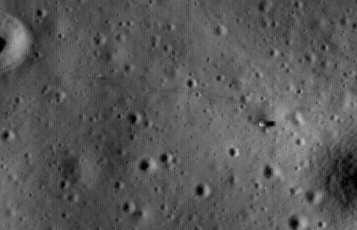
What is It?

What is It?

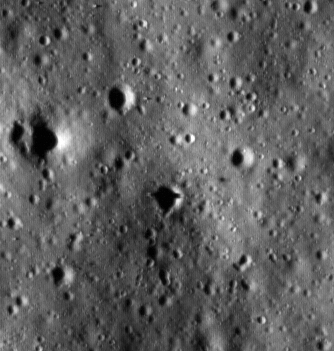
Can you tell what you are looking at in this picture? Hint: In the dead center of the picture, look for something that doesn’t cast a shadow like anything else. Instead of a depression, look for a tiny bright spot that casts a long shadow horizontally across the moon’s surface.

Did you find it? You’re looking at the Apollo 11 Lunar Module! (Actually, it’s just the descent stage, which remained on the moon when Neil Armstrong and Buzz Aldrin took off in the ascent stage.)

The Lunar Reconnaissance Orbiter (LRO) took the picture earlier this month, along with photographs of all the other Apollo landing sites except for Apollo 12. NASA released all the photographs today.

This is a piece of news that SHOULD be about as surprising as, “Scientists today released photographic proof that the sky is blue.” Nevertheless, it is actually huge, because there has been a small but vocal contingent of people claiming in recent years that all of the Apollo moon landings were faked. They even managed to convince the Fox television network to run a special about the “moon hoax” a few years ago. It’s now going to get a lot harder for them to make their case.

The place you should go to read about all of this is Phil Plait’s wonderful blog, Bad Astronomy. Plait has run a website and a blog for years that debunks silly claims like UFOs, faces on Mars, etc. … and one of the battles that he has fought all this time is the one against the moon-hoaxers. So for him, the release of these NASA images must be a huge personal triumph.

What’s so great about it is that here is one case where the conspiracy theorists have gotten themselves trapped — they have occupied a position that can slowly, bit by bit, get chopped out from underneath them, as the LRO missions and other missions get higher- and higher-resolution pictures. This is something that we can only dream of in some of the other contentious non-debates that science has to deal with. Imagine, for example, that we could actually go back into the past and get photographic proof of evolution happening … but we’ll never be able to do that. And so the evolutionism versus creationism non-debate will go on forever. However, for the moon-hoax non-debate, I think the end may be in sight.

Now let’s put that aside, like a bad dream, and also appreciate these pictures for what they show. I love the Apollo 11 picture precisely because the Apollo 11 lander is so different from anything else in the picture. It really says, “We are the aliens here.”

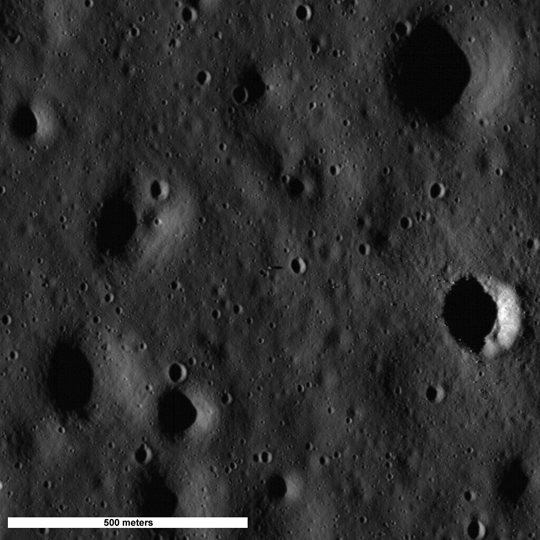
Next, here is part of the photograph of the Apollo 14 landing site.

Apollo 14 Landing Site

Apollo 14 Landing Site

Here the lighting was so good that you can actually see the astronauts’ footprints leading from the lander (right) to the Apollo Lunar Surface Experiments Package (left of center). Amazing! Of course, as my wife said, “Are those footprints or footprint-shaped craters?”  ;-)

Also the photograph of the Apollo 16 landing site documents another little bit of Apollo history:

Apollo 16 landing site

Apollo 16 landing site

In this one you can see the shadow of the lander extending all the way across a nearby crater. Apollo 16 came perilously close to landing in this crater, and the photo shows what a close call it was. Quoting from David M. Harland’s book, Exploring the Moon: The Apollo Expeditions: “They were in the centre of a subdued crater about 100 metres wide. What they did not discover until they ventured outside, was that the rear footpad was a mere 3 metres beyond the rim of the 15 metre crater that Young had lost sight of [while landing the LM]. When he had hovered to select a spot on which to land, he was directly over the crater, and had narrowly missed landing on the rim.”

Fascinating stuff, and a wonderful 40th-anniversary treat from NASA!

Tags: Apollo, Apollo 11, David Harland, footprints, landers, LRO, lunar surface, Phil Plait
Posted in Media, Missions | 3 Comments »

Forty Years Ago

Thursday, July 16th, 2009

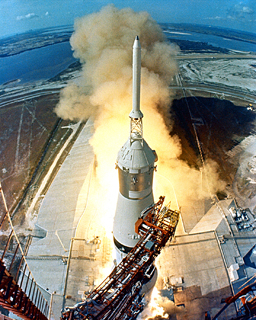
Apollo 11 Launch -- 9:32 AM, July 16, 1969

Apollo 11 Launch -- 9:32 AM, July 16, 1969

 ”If God had wanted man to become a spacefaring species, he would have given man a moon.” — Krafft Ehricke

Q: “Was there ever a moment on the moon when either one of you were just a little bit spellbound by what was going on?” — A: “About two and a half hours.” — Neil Armstrong (Postflight Crew Press Conference, 8/12/1969)

Forty years ago today, the Apollo 11 astronauts started out on the first journey of humans to another world. At that time I was a 10-year-old boy, and very much caught up in moon fever. Of course I watched the launch, the landing, and Armstrong’s famous first step on the moon. The astronauts’ moon walk occurred after my usual bedtime, so it was kind of like getting to stay up late on New Year’s Eve or Christmas Eve.

I spent some time today checking out websites about the fortieth anniversary. Probably the coolest one has to be www.wechoosethemoon.org, a production of the John F. Kennedy Presidential Library, which has streaming audio of the mission just as it was recorded 40 years ago. Unfortunately, when I visited the site it was 40 years after the astronauts went to sleep, so there wasn’t any conversation going on, just static! But still there was a nice animation of where the astronauts were at that time, and some little factoids about the 60s in the corner of the screen.

NASA has a list of anniversary events going on around the country. I’m planning to attend one of them, the Moonfest at NASA Ames Research Center on Sunday, which will be followed up by the second annual Lunar Science Forum from Tuesday to Thursday next week. To my mind, the latter is really the most exciting moon event next week. That’s because unlike all the other events, it focuses on what is going on right now, instead of looking back forty years. I plan to attend on Tuesday at least, and I definitely plan on blogging about it.

Smithsonian Magazine has a couple of interesting articles on its website. One, “Moonwalk Launch Party,”  was written by a photographer who took pictures of people watching the launch. Be sure to check out the comments. Several readers talk about their memories of the launch, and one reader even says that he (at age three) is in one of the pictures! (Click on “Photo Gallery” to see the pictures.) Another article, “Apollo 11′s Giant Leap for Mankind,” is about the Lunar Module — perhaps the most unique piece of technology developed for the Apollo landings. Nothing like the Lunar Module had ever been made before. It would be useless on Earth; it was technology that only made sense on the moon.

Smithsonian’s sister magazine, Air & Space, has a treasure trove of articles, some old and some new, on the Apollo missions. They call it “An Apollo Anthology.” I’ve just begun to dig into it. Check out, for example, “Apollo’s Army,” which talks about the other 400,000 people (besides the astronauts) who worked on Apollo. The reader comments on this one are really good, too. The article and the comments make you realize how the missions were a shared endeavor of our whole country. Also, Air & Space has a blog, Apollo Plus 40, that will be running all this month, so you can keep coming back to it.

Finally, after reading all the rah-rah stuff, maybe you will be ready for a rather dyspeptic article that basically bids good riddance to the moon. If so, check out Robin McKie’s article in the Guardian. As you might guess, I don’t really agree with McKie’s point of view. But I think that it’s important for all moon supporters, like me, to listen to and think about his arguments.

Tags: Apollo 11, looking back, looking forward, websites
Posted in Media, Missions | No Comments »

History Channel, Part 2

Wednesday, July 15th, 2009


Ironically, I had barely finished my interview with the History Channel when my favorite web-comic, Jorge Cham’s Piled Higher and Deeper, ran a series about what happens when a TV crew comes to the lab! As always, Jorge manages to skewer everybody — the vain professor, the clueless TV producer, the grad students who are thrilled just to get the back of their heads on TV. If you haven’t ever read P.H.D. before, go and check it out!

However, my experience with the History Channel has so far been much better than the fictitious film crew in Jorge’s comic. Admittedly we had some struggles with the wind (see my previous entry), but on the whole I was impressed by how hard the producer/writer, Adrian, was working to get the story right within a very limited time frame.

Since he filmed the interview, Adrian has continued to ask me some questions by e-mail and telephone. One particular point has come up over and over: Does the moon have anything to do with Earth’s geology, in particular our uneven distribution of oceans and continents?

The question is a very interesting one scientifically, and it is also interesting as an example of the difficult interaction between science and popular culture… the interaction that Jorge’s comic was all about. Let me take up the science first, and then at the end I will talk about the popular culture aspect.

I’ll start with the assumption that you know about the giant impact hypothesis of the formation of the moon. That is the central topic of my book, The Big Splat, or How Our Moon Came to Be. So if you you have not heard of the giant impact theory, please go to Amazon.com (or your library) posthaste and get yourself a copy. Once you realize that Earth ran into another planet 4.5 billion years ago, a very natural question may occur to you. In fact, this is the first question I heard from the mouth of a little girl, maybe six years old, when she saw a museum exhibit about the giant impact: “But where’s the hole?” Or to ask a somewhat more sophisticated version of the question:

Did the giant impact create a giant hole in the Earth, which later filled in with water and became an ocean?

The answer is NO! I wrote about this in Chapter 12 of my book. The giant impact left no scar that is visible on today’s Earth, for several reasons. First, it catastrophically blew off a large part of Earth’s mantle, most of which fell back to Earth and reassembled into the nice round planet we see today. That reassembly process erased any “hole” that was temporarily created. The energy of the reassembly melted Earth’s surface and created a magma ocean, which also tended to smooth out any surface scars.

[In fact, on the History Channel episode from season 1, Robin Canup, who has done extensive computer simulations of the giant impact, says that the Earth was basically back to being round again within one day of the impact. We forget how strong gravity is on a planetary scale -- that's why everything in the solar system that is larger than a certain size (about 500 miles in diameter) is round. Gravity is able to overcome the shear strength of rocks.]

The idea of the Pacific Ocean as a remnant of the moon’s formation is actually an old one that long predates the giant impact theory. When George Darwin proposed his fission theory in 1879, a geologist named Osmond Fisher suggested that the Pacific Ocean could be the place from which the moon detached from Earth. At that time the formation of oceans and continents was not understood. However, we now know that oceans and continents are formed by plate tectonics. Earth’s continents have broken up and re-assembled several times over the last 4 billion years, and the shapes of the oceans have changed along with them.  The crust that lies under the Pacific Ocean today is almost all younger than 300 million years old — and thus it is certainly not the scar of an event that occurred 4.5 billion years ago.

Okay, so the oceans and continents are formed by plate tectonics. But what caused Earth’s crust to break up into pieces in the first place? Wasn’t that due to the giant impact?

Again, the answer is no! Earth’s surface wasn’t like a Christmas ornament, fracturing into pieces when it hits the floor. The giant impact liquefied Earth’s surface. Any fracturing into pieces had to occur later.

But there is also a more fundamental point. Plate tectonics is a process that is driven by energy within the Earth. The mantle is a hot, fluid layer thousands of miles deep, and the crust is a very thin, brittle layer on top of it that is only tens of miles deep. You might be surprised to hear the mantle described as a fluid, even though its composition is rock. But on the time scale of hundreds of millions of years, the rock can move around. Most geophysicists believe that it is convection within the mantle — a rolling motion, such as what you see when you heat a pan of water up to the boiling point — that drives plate tectonics. This slow churning in Earth’s interior creates stresses at the surface that the brittle crust cannot withstand. So it fractures into lithospheric plates, and then the convection causes those plates to move around.

Okay, so the giant impact didn’t create the oceans directly and it didn’t create the lithospheric plates directly. But didn’t all that energy from the impact heat up our mantle and start that convection process?

Now the questions are getting better! When you start talking about energy, you’re starting to think like a physicist.

But still, there is a question of time scales to think about. The energy directly deposited by the impactor, and by the rain of debris back to Earth, did not last very long. Both on Earth and on the moon, there is evidence from grains of zircon that the magma oceans must have solidified by 4.4 billion years ago — in other words, they lasted at most 100 million years after the giant impact, and probably less. So even though the giant impact did heat the surface of our planet up, that heat dissipated long ago, and it does not explain where the energy behind plate tectonics — the energy that produces earthquakes today – comes from.

So where does the energy come from?

Glad you asked! It comes from the decay of radioactive elements, principally uranium and thorium, within Earth’s mantle. That’s right, our planet is warmed by nuclear power!

The elements I’ve mentioned happen to have half-lives that are roughly on the same scale as the age of our planet. (Uranium-238 has a half-life of 4.5 billion years; thorium-232 has a half-life of 14 billion years; Earth is about 4.56 billion years old.) An element with a much shorter half-life would decay too rapidly, and there would no longer be enough of it around to heat our planet. A radioactive element with a much longer half-life would not generate enough heat to be significant.

So you can thank the elements uranium and thorium, with a nod to Mr. Einstein, for almost all of our geothermal energy — for volcanoes and earthquakes and the movement of continents, which affects the evolution of life. This is a tremendously important story, which viewers of the History Channel ought to hear. However, the moon does not have anything to do with it. Or to put it a little less categorically, I don’t see what the moon has to do with it. If a reputable geophysicist comes along with a good explanation, then I will be very happy to change my tune.

But didn’t the giant impact give Earth an extra-large core, and isn’t it energy from Earth’s core that causes plate tectonics? So perhaps we have a tectonically active planet because of our large molten iron core.

This is the best question of all, and it’s the only one for which I feel less than 100 percent confident about my answer. It is correct that Earth has an anomalously large core for a planet its size — about 3/8 of the planet’s mass. One of the key motivations for the giant impact hypothesis was to explain this anomaly. (Computer simulations show that the impactor’s core joins Earth, while the impactor’s mantle gets blasted into orbit.)

But is it correct to say that the energy for plate tectonics is generated in the core? This is the part I’m not sure of, but I think the answer is no. The reason is kind of technical. Uranium and thorium are lithophile elements, which means they “prefer” to be in rock instead of alloying with iron. When Earth  (or the impactor, for that matter) differentiated into a planet with an iron core and a rocky mantle, elements (called siderophiles) that like to alloy with iron tended to migrate into the core, while the lithophiles tended to remain in the mantle. Therefore, while there is plenty of evidence that we got an extra infusion of iron and nickel from the impactor, that does not mean we have an extra-large reserve of uranium and thorium.

Less technically, here is how I think about it. The impactor gave us an extra-large radiator (that big blob of iron and nickel in the center of the planet). But installing an extra-large radiator does not make your house any warmer. To make the house warmer, you need more fuel — in this case, uranium and thorium. And I don’t think that we got extra fuel from the impactor.

So, in conclusion: As far as I know, the moon has nothing to do with plate tectonics, and therefore it has very little to do with what is going on in Earth’s lithosphere. (The hydrosphere is another question — obviously, the moon has plenty to do with tides.) My geologist colleagues whom I consulted on this question, Brian Skinner and Barb Murck, were very emphatic about this, and so I have tried to “fight the good fight” and warn Adrian not to make any direct moon-geology connections. I’m sure he has gotten similar advice from other people, too.

The fact that these questions keep coming up, seemingly from on high, makes me think that the “network execs” wish there was a sexy connection between the giant impact and Earth’s oceans, plate tectonics, etc. That would be good TV! But I hope that in the actual episode they will stick to what the scientists tell them. It will be very interesting to see how the show finally comes out!

Tags: core, energy, geology, giant impact, History Channel, iron, plate tectonics, science and society, The Universe
Posted in Media, Science | 2 Comments »

New Scientist cover!

Monday, July 13th, 2009


Forty years later

Forty years later

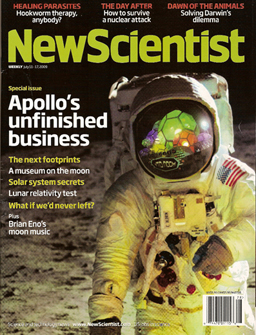
In honor of the 40th anniversary of the Apollo 11, New Scientist has a special eight-page feature this week on the legacy of Apollo, called “Why the moon still matters.” I wrote the cover story, to which they gave the provocative but also quite appropriate title, “It’s the solar system, stupid.”

Although I didn’t make up the title, I think it rather nicely sums up the main message of my article, which is that by studying the moon rocks we learned about a lot more than just the moon — we learned about how the whole solar system was put together.

Besides my article, there are four other articles in the package, all very much worth reading. Stuart Clark writes about an experiment that the astronauts left on the moon that is still returning data, 40 years later: the laser reflectors that are used to measure the distance from Earth to the moon. Greg Klerkx asks what the nationality of the next person to set foot on the moon will be. Hint: There’s a very good chance that he (or she) won’t be American. Linda Geddes discusses plans to preserve the historic sites of the early moon landings. Ironically, they won’t need any preservation at all until humans start going back to the moon — but then we will have to think about how to keep every space tourist from placing their boot print next to Neil Armstrong’s. Finally, Henry Spencer speculates about what life on the moon (pop. 5000) would be like today if we hadn’t stopped sending astronauts to the moon in 1972. By the way, I think his scenario is a little bit too optimistic, but that’s what makes speculation fun.

Elsewhere in the issue, there is a short interview with Brian Eno, who wrote a musical composition called “Apollo” in 1983, which will have its first live performance at the Science Museum in London on July 20. I learned something from this interview I never knew before: “Every [Apollo] astronaut was allowed to take one cassette of their favorite music. All but one took country and western,” Eno said. I wonder who the one was?

The New Scientist website also has a comments forum. One guy wrote in and said that he doesn’t understand why we aren’t sending robot missions up to the moon every month by now. “I WANT MY MOON ROVERS!!” he wrote. That’s the spirit! Unfortunately, the New Scientist site includes some comments by the tiresome and rather sad people who believe that the moon landings were faked. If you want to discuss the articles without having to read such pointless debates, please feel free to comment here. I promise to delete all comments from moon-hoax-conspiracy theorists.

P.S. for word fans: In my article I used the word “gambolled” in print for the first time! According to the fascinating website www.wordcount.org, “gambolling” is the 81,852-nd most common word in the English language. Amazingly, it follows “atns” (huh?) but it is more common than “sundae.” The word “gambolled” is not listed.

Tags: anniversary, Apollo, music, solar system, speculation
Posted in Media, Science | No Comments »

History Channel, Part 1

Saturday, July 11th, 2009


One of the coolest perks of publishing a book about the moon was the chance to talk on television about it. My first interview on the History Channel aired in 2007, and just a month ago I had a chance to film a second one. For readers of my chess blog, this is already old news, because I wrote about it last month. I would have written about it here, but I had not created this blog yet! In fact, my upcoming appearance on the History Channel was one of the things that motivated me to start this blog.

In my next entry I will write about what has happened with respect to the History Channel episode since my interview. But first things first — here is the story of the interview itself (copied and pasted from my June 15 post in “dana blogs chess”).

Last Friday (June 12) I had my second interview with the History Channel for their program “The Universe.” If you have visited my static web page, you might know that I appeared in an episode from season one of this program, back in 2007, called “The Moon.” They are now recording episodes for the fourth season, which will air this fall, and interviewed me for another episode about the moon. I’m probably not supposed to say anything in detail about it (for example, the tentative title), so I’ll leave it at that.

The producer, cameraman and sound engineer came up to Santa Cruz to film an interview with me and one other person. They asked me to suggest a location and I picked Natural Bridges State Beach. I went to scout out the location on Thursday and wondered if I might regret it, because it was kind of windy.

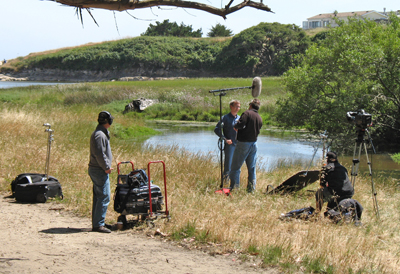
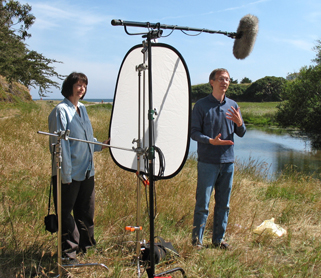
As it turned out, it was even windier on Friday, and the shoot was quite an adventure! Here is the film crew and me, setting up:

Dan, the sound guy, is on the left. I’m in the center; the producer, Adrian, is right next to me, and the video guy, Ken, is on the right. By the way, I might have Dan and Ken backwards. If so, I apologize!! Adrian really liked this location. As you can see, there is an estuary in the background that meanders out to sea. You can’t see the ocean in this shot (it’s behind the bluff), but from the spot where Ken is setting up the camera you could easily see the ocean with some nice breakers in the background.

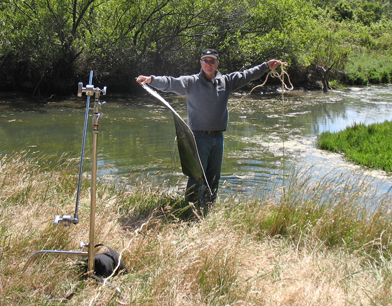
The adventures started right away, when the wind blew their reflector off its tripod and into the estuary! The reflector is a piece of white foam board that is supposed to reflect the sunlight onto the dark side of my face, thereby softening the shadows. Here is Dan, after fishing the reflector out of the estuary:

Fortunately they had a backup. But with the wind gusting at around 30 mph, it didn’t look as if it would last long, either. What to do? Well, as luck would have it, my wife, Kay, had come along to watch the interview and take photographs. I suggested that she could hold the reflector to keep it from blowing away, and eventually they agreed with me. Adrian said that when he earns an Emmy for this show, Kay can come up and accept the award with him!

Here Kay shows why they call the production assistants “grips”:

That wasn’t the only adventure. I brought a prop with me, a gyroscope to illustrate the principles of angular momentum. We shot a couple of takes where I would start the gyroscope spinning, hand it to Kay, then stretch a string between my hands, and then Kay would put the gyroscope onto the string. Notice that a key ingredient in this procedure was that I had to hold onto the string after using it to start the gyroscope spinning. Well, the third time we did it, I accidentally let go of the string, and when I looked down to see where it had landed, it was nowhere to be found. By then I’m sure the wind had taken it and blown it halfway to San Jose. So I’ll just have to hope that takes one and two were good enough.

(Sigh.)

Aside from that, the interview went pretty well. As always, I loved talking about the moon, and I hope that they will pick moments from the interview where that love and enthusiasm comes out.

Tags: angular momentum, History Channel, interview, The Universe, wind
Posted in Media, Science | 2 Comments »

New Moon Crater Discovered, or Why You Shouldn’t Pack Your Globe in a Suitcase

Monday, July 6th, 2009


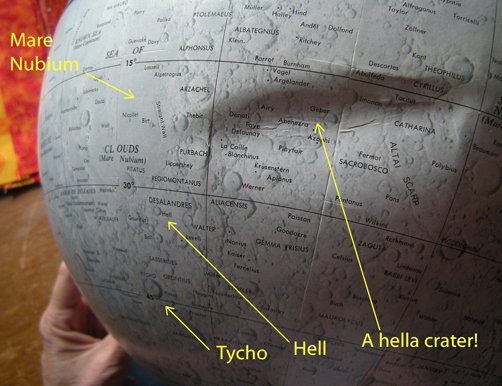
In my last entry I wrote about the first LRO image, which was acquired over a narrow swath of territory near a crater with the curious name of Hell. Naturally, I wanted to see where this crater was, so I got out my lunar globe.

So first I have to tell you a story about this globe. I bought it at the Johnson Space Center gift shop in 2003, while I was attending the Lunar and Planetary Science Conference in Houston. At that time my book was almost ready to come out — in fact, I think the publication date was only a week or two after the conference ended. I saw this globe in the gift shop, and thought it would be a good idea for me to have a lunar globe that I could refer to when I was giving book readings. Seventy-five dollars later, the globe was mine. They were probably glad to get rid of it; after all, who goes around buying lunar globes these days? In fact, the globe came with an information booklet that clearly had not been updated since the early 1970s.

Unfortunately, I decided to bring the globe back home in my suitcase. As my wife will tell you, I don’t have a lot of common sense. And when I got back to California, I discovered my beautiful new lunar globe … with two new craters that hadn’t been there before.

One of them happens to be close to the place that I was writing about in my last blog post. So when I showed my wife where Hell Crater was, she deadpanned: “That’s a hella crater, all right!”

Don't Let This Happen to Your Globe

Don't Let This Happen to Your Globe

Tags: LPSC, LRO, spousal overunit
Posted in Just for Fun | 2 Comments »

LRO First Picture!

Saturday, July 4th, 2009

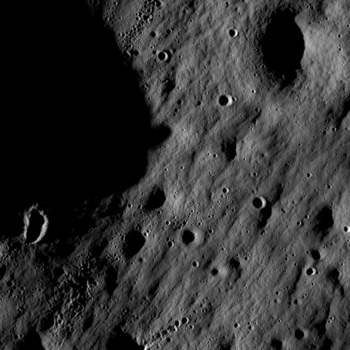
Two days ago, on July 2, NASA released the first photograph from the new Lunar Reconnaissance Orbiter. And here it is! (Actually, this is just a small piece of it, but a very interesting piece, as I will explain below.)

LRO First Light

LRO First Light

The complete photograph is actually a very long strip, something like 500 by 50,000 pixels, taken near the edge of Mare Nubium in the moon’s southern hemisphere. The LRO website ways that the photo was taken near a crater called Hell … I’m not sure why. It doesn’t seem like the best place to start a mission!

If you want to find the location through a telescope or binoculars, it’s at about 30 degrees south latitude and 10 degrees west longitude. To the south is Tycho (one of the brightest craters on the moon), and to the north is an easily spotted trio of craters, Ptolemy, Alphonsus, and Arzachel. The best time for looking at this region was two days ago, when the picture was taken — and that is no accident. Photographers on Earth like to take pictures at sunset or sunrise, and so do lunar photographers! The lunar topography shows up most clearly near the “terminator” — the boundary between the day side and night side of the moon. The LRO spacecraft is currently in a terminator orbit, circling the moon from pole to pole and following the moon shadow around. This is the place to be if you want to take stunning photographs!

There are two very interesting things to notice in this picture. First, at the very bottom, you might notice a string of craters, like beads on a chain. Is this an accident? If not, how is a chain of craters like this formed? The answer is that they are “secondary craters” — craters formed by debris that is blasted off the moon’s surface by a meteorite impact. When the debris lands, it forms smaller craters all in a line. The first person to notice this phenomenon, I believe (perhaps some historians can correct me if I’m wrong) was Ralph Baldwin, an amateur astronomer in the 1940s. At the time, the conventional wisdom was that the moon’s craters were volcanoes. Baldwin put together many pieces of evidence, like this, to conclude that at least some of them were formed by impacts.  In this case, the amateur was right and the professionals were wrong.

Also, Baldwin noticed very large-scale linear patterns on the moon, which again seem to radiate outward from some of the great basin impacts. According to the LRO team, you can see some of the linear features in the photograph. I suspect that what they mean is the overall southwest-northeast orientation of the valleys in this photo. These furrows must have been scoured out by a vastly larger and earlier impact than the one that made the little chain of craters that I mentioned above.

As cool as the LRO pictures are, I want to mention that LRO is way, WAY more than just a camera. It has seven extremely cool instruments on it. I will list them below in no particular order of coolness. I will not translate the abbreviations into English — if you want to know what they stand for, check out the LRO website.

  1. LAMP. How cool is this? We are going to see the dark regions of the moon by starlight. The stars give off ultraviolet light, and the whole darned galaxy glows at one particular wavelength, and we can use this invisible (to human eyes) light to peer into craters that never see the sun.
  2. Diviner. We’re going to take the moon’s temperature. It’s not the same everywhere. Equatorial regions range from 150 degrees below zero (Celsius) to more than 100 degrees above zero (i.e., hotter than the boiling point of water).If you’re building a lunar base, that’s kind of tough to deal with. But near the poles, the temperature is much more even, although cold — roughly 100 to 120 degrees below zero.
  3. CRaTER. This one is interesting because it is specifically directed towards human habitation. How much radiation does the moon get from the sun and from outer space? The answer will tell us how long we can keep astronauts on the moon’s surface safely. Remember that the Apollo astronauts were there for only three days or less.
  4. LEND. Another instrument that will measure radiation — this time neutrons coming from inside the moon. This is kind of a repeat of the experiment that Lunar Prospector did to confirm the presence of hydrogen (and therefore maybe water) at the poles. An interesting point here is that it’s a Russian experiment flying on a NASA spacecraft — a nice example of international collaboration!
  5. LOLA. This laser altimeter will construct 3-D images of the moon’s surface.
  6. Mini-RF. A synthetic aperture radar that will search for ice at the lunar poles. This is similar to the Clementine experiment in 1994 that started all the excitement about water at the poles, but I assume it will be much better because it will have a lot more time to gather data and because it was designed for this purpose.
  7. LROC, the LRO camera, which by now needs no introduction.

I am by no means an expert in all of these technologies (or any of them), but I hope that over the coming months I will have a chance to interview some of the scientists involved with these projects, so that I can tell you how they work.

One thing that I find interesting about the web links is that almost all of them mention that they are “heritage” or “legacy” instruments — in other words, similar experiments have flown on other NASA missions, to Mars or to other planets. In our budget-conscious age, NASA wants equipment that is cheap and reliable. Still, one can’t help feeling a little bit nostalgic for the 1960s and the Apollo missions, when nothing was a legacy experiment — everything was being done for the first time!

Tags: craters, equator, ice, LRO, NASA, opinions, poles, radiation, technology, telescope, water
Posted in Missions, Science | 5 Comments »

<< Previous

  • Categories

    • Arrive (2)
    • Future exploration (6)
    • Just for Fun (10)
    • Media (18)
    • Meetings (7)
    • Missions (17)
    • Movies (1)
    • NASA (13)
    • Popular culture (4)
    • Science (29)
    • Survive (1)
    • Thrive (1)
    • websites (5)
  • Subscribe

    Subscribe in a reader
    Subscribe by email
  • Earthly links

    • dana blogs chess
    • Dana's website
  • Lunar links

    • Bad Astronomy
    • Emily Lakdawalla – Planetary Society Blog
    • Lunar Picture of the Day
    • Moon-Wiki
    • Paul Spudis – The Once and Future Moon
    • Space.com
    • The Big Splat, or How Our Moon Came to Be
    • Wandering Space
  • Recent posts

    • Hiatus
    • Obama’s Speech — Some Cheers, Some Jeers
    • Discover article on the Moon
    • New Scientist article
    • The Moon and Easter
    • Lunar water update
    • Change of Pace — and Puzzle
  • Previous posts

    • June 2010 (1)
    • April 2010 (3)
    • March 2010 (2)
    • February 2010 (1)
    • January 2010 (3)
    • December 2009 (3)
    • November 2009 (4)
    • October 2009 (2)
    • September 2009 (4)
    • August 2009 (5)
    • July 2009 (11)

Copyright © 2013 - Who Hung the Moon? | Entries (RSS) | Comments (RSS)

WordPress theme based on 9ths Current designed by web design