• Home
  • About the Author
  • About the Blog
  • About the Book

Posts Tagged ‘New Scientist’

New Scientist article

Tuesday, April 6th, 2010

My article for New Scientist about the discovery of more-abundant-than-expected lunar water finally reached the newsstands last week. I’d like to welcome any readers of that article who have come to this blog looking for more information.

This article had quite a long gestation period. I first pitched the idea of an article about the LCROSS mission to my editor about a year and a half ago, but at the time she didn’t really see the news value of the story. Before the LCROSS mission lifted off, there wasn’t a whole lot of excitement about it in the media. But then a lot of things changed. The Chandrayaan-1 discovery of surface water on the moon. David Letterman’s skit that poked fun at the idea of “bombing the moon.” The very successful impact that dug up a lot of water, plus other volatile compounds.

At the same time, a big policy debate was going on about our future in space, with the Augustine Commission issuing its report about the same time as LCROSS was hitting its target. That debate culminated in February, when President Obama recommended the cancellation of the Constellation Program and redirected NASA’s priorities for the next decade.

With all of these things going on, I think it is fair to say that the moon and lunar water was one of the top stories in solar system science over the last few months.

I wrote the first draft of the New Scientist article in December, following the Lunar Exploration Analysis Group meeting in Houston (November) and the American Geophysical Union meeting in San Francisco (December). I really wanted the article to come out then, when it could still (maybe, in some far-fetched scenario) have had some effect on the policy debate.

However, the article got delayed until April, not for any political reasons but just because New Scientist feature articles get put into a queue and it takes some time for them to work their way through that queue. Meanwhile, the Obama decision happened and so I had to revise the article to reflect that reality.

In the end, I failed in my original goal of writing an article that would perhaps have an influence on the future. However, I do think that the article itself came out a little bit stronger as a result of the delay. I was able to replace some of the “ifs” and “possibly”s and “could be”s with more definite statements. In some sense it became a retrospective on the lunar water story of 2009, rather than a story-in-progress as I originally conceived it. However, I would like to emphasize that there is still a story in progress, as the LCROSS data and LRO data continue to come in and become better understood.

Tags: Augustine Commission, Chandrayaan-1, David Letterman, LCROSS, LRO, New Scientist, Obama, retrospective, water
Posted in Media, Meetings, Missions, NASA, Science | No Comments »

Guide to the Cosmos, gold, New Scientist

Monday, January 11th, 2010

As of today, I’m on a podcast! Check out “Guide to the Cosmos,” a podcast hosted by Dr. Robert Piccioni, at www.guidetothecosmos.com. It was actually Christmas Eve Day when we recorded this interview over the phone, and it’s a two-parter. The first part, in today’s episode, is about water on the moon, and I talk all about the recent discoveries by Chandrayaan-1 and LCROSS. The second part is about the origin of the moon, and that part of the interview will air in February.

The audio part of the podcast is actually on a different site, called WebTalkRadio. You can go to their main site, www.webtalkradio.net, and then look for “Guide to the Cosmos” under the “Show podcasts” tab. But I’ll make it easy for you and give you a direct link. Dr. Piccioni also puts some images up on his own website to go with the podcast, which you can look at here as you listen to the interview.

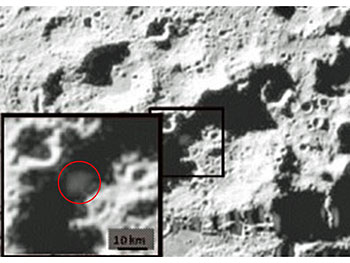
When I recorded the interview I did not know which images he was going to have up on his website, so I wasn’t able to refer to them directly. Let me fill in that gap here. Image #1 shows the impact plume from LCROSS’s crash into the Cabeus crater.
Cabeus impact plume

Cabeus impact plume

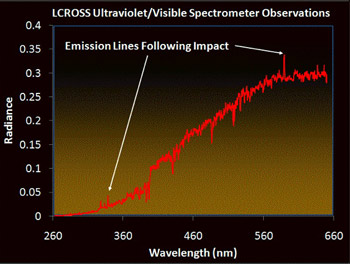
This cloud of debris was not visible from Earth. The photo was taken from the “shepherding satellite” that passed directly overhead and crashed into the moon 4 minutes later. The spectrometers on the shepherding satellite analyzed both the absorbed and emitted light from this cloud to look for traces of water and other compounds. Image #2 is just a pretty picture of the full moon, nothing else. The LCROSS impact happened way down at the bottom of that picture, in the bumpy area around the south pole. Image #3 is a “wiggly line” from the ultraviolet and visible spectrometer.
Spectrum showing sodium emission line plus something interesting

Spectrum showing sodium emission line plus something interesting

Interestingly, this is not the data set that Tony Colaprete, the main project scientist, has talked about the most. Unlike the near infrared spectrometer, whose readings they understand pretty well and which show definitive evidence of water, the UV/VIS spectrum requires more interpretation and they are just beginning to work on it. The peak on the right is actually not water but sodium. (This emission band looks yellow to the naked eye, and explains why a sodium lamp is yellow. See this Wikipedia entry to read more about it.)

You can also see two shorter peaks on the left that have not been identified yet. At the AGU meeting in December, Tony said they think that one of them could be gold! Yes, gold on the moon. You read about it here first.

Back in the days before Apollo went to the moon, there was a slightly kooky scientist named Tommy Gold who said that the moon was covered by a layer of dust so deep that any spacecraft that landed on the moon would just sink into it and never be seen again. Fortunately, this didn’t turn out to be the case, but for a while NASA had to take the possibility seriously, and his hypothetical surface layer became known as “Gold dust.” But now lunar gold dust may take on a whole new meaning!

I did not report on this earlier (”LCROSS Strikes Gold!”) because they really don’t know what the peaks are yet, and so Tony’s comment was at least partly meant in jest. If they ever get more serious about it, I’ll be sure to let you know.

Last month I wrote an article for New Scientist online about the moon sessions at the AGU meeting, called “Are We Looking in the Wrong Places for Water on the Moon?” This was a very ticklish article to write, but I was happy with it in the end. Basically, the story is that one of the instruments on the Lunar Reconnaissance Orbiter (LRO) has been seeing lots of indications of water in places where it isn’t supposed to be.

LCROSS went to a permanently shadowed crater because that is where theory says that lunar water, if it exists, should concentrate. It went to Cabeus, in particular, because that is where the Lunar Exploration Neutron Detector (LEND) on LRO saw the highest concentrations of water. But what’s interesting, and controversial, is that LEND has seen no correlation so far between permanent shadowing and hydrogen deposits! There are other regions with just as much water as Cabeus that aren’t in shadow.

What made the article ticklish to write is that there are some people who frankly don’t believe the LEND data yet. I tried to hint at this without pouring oil onto the fire. But there are three groups–one in Russia, two in the U.S.–who are working on the LEND data and they all are saying pretty much the same thing. You can’t just ignore this fact and pretend it isn’t there, while at the same time singing the praises of LCROSS and the LRO camera and the other experiments on LRO. That’s why I felt it was important to write this article, even if the jury is still out on what the results mean.

In a blog I think I can be more adventurous than I can in print, so I’ll hazard a guess as to what it might mean. The LCROSS results are hinting that there is way more water than you can produce by bombarding the moon’s surface with the solar wind–some of the water has to be from meteoroids or comets. LEND can see beneath the surface, and Igor Mitrofanov, the principal investigator for LEND, says that he thinks they are seeing deposits of hydrogen that lie beneath the surface, covered by a layer of dry soil. Putting two and two together, I think that the water is delivered by meteoroids/comets, and is then buried by some process we don’t understand yet (or maybe it’s just in a sufficiently thick layer to begin with?). Once it’s buried, it doesn’t need a permanently shadowed crater to keep it from evaporating. Sure, it might be associated with a permanently shadowed crater, but really any crater will do. Or maybe even something that isn’t a crater! One of the most puzzling things about the LEND data was that one of the hydrogen deposits seemed to be on one side of a mountain range. But maybe that makes sense, if the mountain range was created by the meteoroid/comet impact.

Well, this is just my feeble amateur speculation. The specialists will, of course, hash it out and either come up with an explanation, or agree to disagree. One thing that’s pretty certain is that there is a lot we don’t know yet.

Tags: Chandrayaan-1, hydrogen, LCROSS, LEND, lunar origin, New Scientist, podcast, Robert Piccioni, Thomas Gold, water, WebTalkRadio
Posted in Media, Meetings, Missions, NASA, Science, websites | 2 Comments »

I’m a Geoblogger!

Thursday, December 17th, 2009


At the American Geophysical Union meeting this week I dicovered that I belong to a small community that I didn’t even know about: I’m a geoblogger! There was a luncheon on Wednesday for people who blog about earth or space sciences, and so I got to meet about fifteen other people who do the same thing.

One of the things that struck me was the diversity of the blogs: the different types of sites, the different reasons for blogging, the different people doing it. Every blog has its own flavor. The majority of the geobloggers were graduate students or faculty, but there were a few journalists too.

So who was there, you ask? Let me introduce you!

Reia Chmielowski came from the longest distance — all the way from Milano. She is a postdoc in metamorphic petrology. Her blog, The Musings of a Life-Long Scholar, takes a personal tone, and it might be of interest to academics outside of geology.

Larry O’Hanlon is a professional journalist who will be blogging for “two more weeks” at Discovery News before passing the blog on to someone else; however, he will still remain very much involved with the site.  He notes that it’s kind of hard to tell the blog apart from the regular news now, because a recent redesign of the site has merged the two.

Claus Haslauer, Dave Petley, Pawam Gupta, and Steve Easterbrook had different approaches to the faculty blog. They are your go-to guys if you are interested in geostatistics, landslides, aerosols, and climate change informatics respectively. To a large extent their blogs are oriented toward colleagues rather than to the public. (Gupta said this explicitly — the purpose of his blog is to “review peer-reviewed papers.”) However, Petley’s blog in particular gets a lot of hits from outside academia, especially when a natural disaster hits. He also says that he attracts a lot of students with his blog, and has begun to be better known for his blog than for his own research! Faculty everywhere, take note!

Carrying the grad student torch were Cassaundra Myers and Julian Lozos, both of UC Riverside. Cassaundra’s blog, UCR GEOP Chalkboard, is more of a departmental blog that other students contribute to (but she does the most work on it). Julian was a wannabe musician, and is now a wannabe seismologist. He has been doing social media of one sort or another since he was a kid, and said that his choice of topics has graduated from “What is your favorite Pokemon?” to “Earthquakes are not the bogeyman.”

Actually, this last comment raises an interesting point. Julian says that people always ask him how he can study something as depressing as earthquakes, but in fact earthquakes give us lots of fascinating information about our planet. Like carnivores with big claws and big sharp teeth, they get a bad rap. To read more about them, check out his blog, Harmonic Tremors.

If there was one blog whose title made me immediately want to go read it, it was probably Brian Shiro’s. He is currently in training to become an astronaut. By some quirk of fate, he learned about an opportunity to apply for astronaut training the very same week he started his blog, Astronaut for Hire. That’s right, he started his blog first and then became an “astronaut for hire”! This is a true example of the power of positive thinking. By the way, his “geo” credentials are that he works at the Pacific Tsunami Warning Center, and his blog contains some posts about that topic as well.

There were two interesting blogs from people who, like me, are academic castaways. Andrew Alden is a former geologist with the US Geological Survey who now is the Geology Guide for about.com. He uses his blog as a front end to his main informational pages on about.com, which get the most traffic. He noted that when he started with about.com, he would write long informative posts, but he has since found that about 80 percent of the people who visit the site just want to look at pictures of rocks!

I hope that Michael Tobis doesn’t mind me describing him as an “academic castaway” because he is in fact employed at the University of Texas, but it sounds as if his job is not really his raison d’etre. “My blog has been the core of my intellectual and social life for the last two years,” he said. His passion is climate change and his blog is called Only In It for the Gold, and you need to check it out.

The name, by the way, is a reference to something someone once said to Tobis at a party. When he told the hostess that he worked on climate change, a hush fell over the room. (Living in Texas, in the heart of oil country, that’s probably as good a conversation-stopper as saying you are an atheist.) His hostess, fumbling for something cheerful to say, said, “Well, I’m sure there is good money in that!”

Finally, three representatives of mainstream publications were also there. Carolyn Gramling blogs for www.earthmagazine.org, Mouse Reusch is one of several writers for the Big Wide World graduate student blog at www.newscientist.com, and Harvey Leifert is a rather infrequent blogger at the Climate Feedback blog at www.nature.com. We forgive Harvey because he is the former public information officer for the American Geophysical Union and thus has done more to promote public understanding of geophysics than all the rest of us put together.

I apologize to any other bloggers who were there whom I haven’t written about, because I had to duck out of the lunch early (actually, at its scheduled ending time) to hear the great debate over the Younger Dryas Boundary. The question: Did an impact from an extraterrestrial object cause the climate cooling 12,900 years ago that maybe caused sabertooth tigers to die out and the Clovis culture to end? To me, the most convincing talk by far was given by Alan Harris of the Space Science Institute. The intrinsic probability of such an event, a 4-kilometer asteroid hitting Earth in the last 13,000 years, is so low that you need extremely compelling proof to overcome it. As a mathematician, I would use Bayes’ Theorem to explain this, but there is an old saying of Carl Sagan that works just as well for non-mathematical folks: “Extraordinary claims require extraordinary evidence.” And the evidence for the alleged impact, so far, falls way way short of being extraordinary.

Well, none of this has much to do with the moon, but it’s just an example of the incredible variety of interesting stuff you can hear about at the AGU meeting.

Tags: aerosols, AGU, astronaut, climate change, Discovery Channel, Earth Magazine, earthquakes, extraordinary, geobloggers, geostatistics, landslides, Nature, New Scientist, off-topic, Younger Dryas Boundary
Posted in Meetings, Science, websites | 5 Comments »

LEAG Conference, part 1

Thursday, November 19th, 2009


I’m back from the Lunar Exploration Analysis Group (LEAG) meeting in Houston, which ran from Monday through Wednesday this week. There was plenty of talk about LCROSS, which one member of the LCROSS science team calls “the little mission that did,” and also lots of discussion about the future of lunar exploration. The big theme of the meeting was sustainability: How do we go back to the moon in such a way that we can keep on going there indefinitely? Many, though not all, of the participants interpreted that question to mean: How can we make the moon economically viable? Of course, the LCROSS mission has a great deal to say about that.

Of course, the talk I looked forward to the most was by Tony Colaprete, the principal investigator for LCROSS. He gave only a few more scraps of information beyond what was reported in the news conference last Friday, but nevertheless I felt that the scraps fit together into an interesting story, which I wrote for the New Scientist website. You can find it here. I concentrated on the discovery of other volatiles besides water, because that was clearly what most interested the people I talked with.

I had to do a little soul-searching, because I go a little farther in the article than Colaprete would go in saying where the water and volatiles probably came from. But isn’t that my job as a journalist? If the experts are pretty sure about piece A, and they are pretty sure about piece B, and if there is only one way that piece A and piece B fit together and everybody knows it, shouldn’t I tell the public about that? Or do I have to wait until, ta-dah!, they hold a press conference and say they are ready to draw conclusion C?

Anyway, there were lots of other interesting and fun things at the meeting. For my blog I will concentrate on personal impressions rather than scientific news.

First, one thing I really loved about this meeting was how much joking and camaraderie there was. I don’t know whether it’s because it is a small enough community that everybody knows each other, or because certain people who are leaders in the community set the tone with their irreverence, or whether it’s just because everyone was in high spirits over the LRO and LCROSS results (and let’s not forget the Chandrayaan-1 results before that). Or maybe it’s just because geologists and planetary scientists are by nature goofy people.

Anyway, the big running joke at the meeting was Larry Taylor’s shorts. After the LCROSS press conference, he was quoted by the New York Times saying that he would have to “eat his shorts.” He was one of the scientists during the Apollo days who came to the conclusion — with good cause, I might add — that the moon rocks were “bone dry” and did not have a scrap of water. He told me that his grandfather used to say that he would “eat his shorts” if he were proved wrong, and so Larry told the newspaper reporter that he would have to eat his shorts now that water had been found in abundance. He had no expectation that this quote would be featured prominently in the Publication of Record. But then he got about 50 e-mails the next day asking if he would have a side of fries with the shorts, and what else he wanted to eat along with them. At the meeting several speakers ribbed him about this, and he finally said that he would eat them if they were served with a bottle of Guinness. Well, with unbelievable alacrity, a four-pack of Guinness beer materialized at the front of the lecture hall! I’m afraid I am not sure whether he eventually made good on his promise (I rather doubt it), but it shows how much fun people had at this meeting.

One of my favorite moments from the meeting was listening to a conversation between Wendell Mendell, another scientist who has been around since the glory days of NASA in the early 1970s, and Igor Mitrofanov, who is sort of his Russian equivalent. They swapped stories about the beginning of the Space Age. Mitrofanov described how when Sergei Korolev wanted to launch the first Russian satellite, he went to the Academy of Sciences, who of course loaded it down with more and more things that they wanted the satellite to do. It looked as if it would take forever, and Korolev was worried that the Americans would launch a satellite first. So he went to Khrushchev, the leader of the Soviet Union, and asked if he could launch a satellite that would just go beep beep beep. Khrushchev said sure, and Sputnik was born. Khruschchev didn’t think much of it, but when Sputnik flew in October 1957 and he saw how panicked the Americans were, he called Korolev back into his office and said, “I want another satellite by November!” (The over-complicated Academy of Sciences satellite did finally get launched, Mitrofanov said, but it was their third satellite.)

Mendell said that President Eisenhower was actually glad to have the Russians launch the first satellite … until he saw the furor that it caused. He wanted to be able to fly satellites over Russia to take spy pictures, because the U-2 airplanes that were doing this job were at risk of being shot down. If the Russians launched the first satellite, they couldn’t very well complain when the Americans launched one of their own. Nice plan, until everyone in the U.S. got hysterical about Sputnik, and the U.S.’s first attempt at a satellite launch blew up.

I guess these stories are probably pretty well known, at least the U.S. side, but I loved the idea of these two scientists, once separated by an Iron Curtain, being able to talk and laugh about these things.

More meeting thoughts and recollections in my next post …

Tags: Chandrayaan-1, Dwight Eisenhower, economics, humor, Igor Mitrofanov, LCROSS, LRO, New Scientist, Nikita Khrushchev, Sergei Korolyev, Sputnik, sustainability, Tony Colaprete, Wendell Mendell
Posted in Just for Fun, Meetings, NASA, Science | 4 Comments »

LCROSS Results Tomorrow

Thursday, November 12th, 2009

Last month the LCROSS satellite crashed into a crater near the Moon’s south pole, in an experiment designed to look for water ice. At that time the principal investigator, Tony Colaprete, said that they would probably announce the results from the mission within two months. Well, they’ve beaten that timeline by a month. Tomorrow there will be a press conference at NASA Ames at 9:00 am Pacific time (12 noon Eastern time) to announce the first findings.

As I wrote in my previous post, the LCROSS impact was sort of a dud from the point of view of public relations.  It was not possible to see the debris plume from an amateur telescope, as the mission planners had hoped. Nevertheless, the instruments on the spacecraft definitely did see the debris. Thus, from an engineering point of view, the mission was a success. They landed the spacecraft where they wanted to land it and they got data.

So that leaves one more question: Was the mission a success scientifically? And in particular, did they find water? That’s the question that I am almost certain will be answered, one way or another, tomorrow. And of course it is the most important question from the viewpoint of future exploration of the moon.

I don’t have any inside information, but Tony Colaprete did say this in an e-mail to me a couple weeks ago: “We have a wonderful data set … It amazes me a little more each and every day.” Read into those tea leaves whatever you will!

In related news, Colaprete and other members of the LCROSS and LRO missions are going to present their early results next week in Houston, at the annual meeting of the Lunar Exploration Analysis Group. Of course the press conference tomorrow will cover anything really big and important, but I’m sure there will be many more details and more discussion at the Houston meeting.

Fortunately, New Scientist has commissioned me to write an article about the status of the lunar water question, taking into account all the results that have been announced this year, from Kaguya to Chandrayaan-1 to LRO and LCROSS. I will attend the Houston meeting, and this will give me a chance to do lots of interviews.

I think we are now at a crossroads in lunar exploration. We’ve gotten a big influx of new data this year, with tantalizing signs that there is more water than we expected on the moon. Now is the time for planning the next steps. Do we shrug our shoulders? Do we invest $3 billion more into the NASA manned flight program, as the Augustine Commission suggested? Do we plan new robotic missions? If so, what should they do?

Lots of questions. Hopefully I’ll find out a few answers, starting tomorrow.

Tags: Houston, LCROSS, LEAG, New Scientist, Tony Colaprete, water
Posted in Media, Missions, NASA, Science | No Comments »

  • Categories

    • Arrive (2)
    • Future exploration (6)
    • Just for Fun (10)
    • Media (18)
    • Meetings (7)
    • Missions (17)
    • Movies (1)
    • NASA (13)
    • Popular culture (4)
    • Science (29)
    • Survive (1)
    • Thrive (1)
    • websites (5)
  • Subscribe

    Subscribe in a reader
    Subscribe by email
  • Lunar links

    • The Big Splat, or How Our Moon Came to Be
    • Emily Lakdawalla – Planetary Society Blog
    • Paul Spudis – The Once and Future Moon
    • Space.com
    • Wandering Space
    • Moon-Wiki
    • Lunar Picture of the Day
    • Bad Astronomy
  • Earthly links

    • dana blogs chess
    • Dana's website
  • Recent posts

    • Hiatus
    • Obama’s Speech — Some Cheers, Some Jeers
    • Discover article on the Moon
    • New Scientist article
    • The Moon and Easter
    • Lunar water update
    • Change of Pace — and Puzzle
  • Previous posts

    • June 2010 (1)
    • April 2010 (3)
    • March 2010 (2)
    • February 2010 (1)
    • January 2010 (3)
    • December 2009 (3)
    • November 2009 (4)
    • October 2009 (2)
    • September 2009 (4)
    • August 2009 (5)
    • July 2009 (11)

Copyright © 2010 - Who Hung the Moon? | Entries (RSS) | Comments (RSS)

WordPress theme based on 9ths Current designed by web design